



B2B Sales Leads Database
A B2B sales leads database is the lifeblood for many businesses aiming to expand their outreach and drive revenue growth. In the intricate realm of business-to-business interactions, having access to a rich, accurate, and up-to-date database can make the difference between missed opportunities and sealed deals.
This article seeks to shed light on the nuances of B2B sales leads databases, emphasising their importance, best practices for their utilisation, and the pitfalls to avoid.
Whether you’re just starting your journey in B2B sales or are looking to amplify your lead generation efforts, this guide promises to be your compass in navigating the complexities of the B2B database world.
Table of contents:
What Is B2B Sales Leads Database?
A B2B sales leads database is a curated collection of information about potential business clients or customers, specifically tailored for business-to-business (B2B) interactions. This database typically contains details such as company names, contact information of key decision-makers, industry classifications, company size, and other relevant data.
The primary purpose of a B2B sales leads database is to assist businesses in identifying and reaching out to potential clients or partners in a targeted manner.
What is a B2B contact database?
At its very essence, a B2B contact database is more than just a list. It’s a dynamic reservoir of business contacts, meticulously curated and tailored for B2B interactions. But, let’s break it down a bit:
- Purpose: The primary aim of such a database is to streamline and enhance the outreach efforts of businesses. It’s about ensuring that your marketing and sales endeavours are laser-focused, targeting the right set of eyes, at the right time.
- Composition: Now, when we talk about a B2B sales leads database, we’re referring to a collection that typically houses names, contact details, business affiliations, and sometimes, even behavioural insights of potential business leads.
- Significance: In the grand scheme of things, the importance of a B2B contact database in the corporate world is monumental. It’s not just about having data; it’s about having the right data. Here’s why:
- Targeted Marketing: With a robust database, businesses can craft marketing campaigns that resonate, that speak directly to the needs and wants of their potential clients.
- Efficient Lead Generation: Gone are the days of shooting in the dark. With a well-maintained B2B sales leads database, businesses can identify, engage, and convert potential leads with heightened efficiency.
- Data-Driven Decisions: In this age of information, decisions backed by concrete data tend to stand out. A B2B contact database provides businesses with the insights they need to make informed choices.
How To Use A B2B Sales Leads Database In Your Day-To-Day Sales Process
A b2b sales leads database is most powerful when it is fully embedded into your daily sales and marketing activity. It should not sit in a spreadsheet that people open once a month. Used properly, it becomes the engine that feeds your pipeline with fresh, relevant opportunities every single week.
To help with that, here is a simple framework for using your b2b sales leads database in a practical, repeatable way.
1. Start With Clear Segments, Not One Big List
Instead of treating your b2b sales leads database as one long list of names, break it into focused segments that match your Ideal Customer Profile.
You might segment by:
-
Sector or SIC code
-
Company size or turnover band
-
Job role and seniority
-
Region or territory
-
Buying stage or previous engagement
This makes it much easier to write messages that feel relevant and to prioritise the segments that usually convert best. At Results Driven Marketing, we build each b2b sales leads database around these segments from day one so your team can start targeting immediately rather than wrestling with raw data.
2. Build Simple Cadences Around Each Segment
Once your segments are in place, create a short contact sequence for each one. This does not need to be complicated. A typical cadence might be:
-
Day 1: Intro email with a clear, single call to action
-
Day 3–4: Follow up email that adds value, such as a tip, checklist, or example
-
Day 6–8: Phone call using a short, benefit driven script
-
Day 10–14: LinkedIn connection and light-touch follow up
The aim is to move leads from cold to conversation without overwhelming them. Your b2b sales leads database provides the structure, and your cadences give your team a clear playbook to follow.
3. Feed Real Outcomes Back Into The Database
The biggest gains come when you treat your b2b sales leads database as a living asset rather than a static file.
Make sure you:
-
Update records after calls and emails
-
Mark leads as interested, not a fit, do not contact, or future follow up
-
Record key notes, such as renewal dates or existing suppliers
-
Remove bounces and role changes as soon as you see them
Over time, this turns your database into a rich history of who has been contacted, what was said, and what happened next. That means less duplication of effort and a much clearer view of where your best opportunities sit.
4. Use Data Insights To Refine Targeting And Messaging
As campaigns go out, your b2b sales leads database quickly starts to show patterns. For example:
-
Certain sectors reply more often
-
Specific job titles book more meetings
-
Some regions respond better to phone than email
Review this data regularly and adjust your targeting and messaging to match what is actually working. Promote the winning segments, pause the underperformers, and top up the areas that are generating real pipeline.
When you combine a well structured b2b sales leads database with disciplined day-to-day use, your team spends far less time guessing and far more time speaking to the right people.
Navigating B2B Contact Databases
The realm of B2B sales leads databases is vast, intricate, and, let’s be honest, a tad overwhelming at times. But, as with any journey, having a roadmap can make all the difference. So, let’s embark on this exploration, shall we?
Why does your business need a B2B contact database?
Now, you might be wondering, “Why all this fuss about a B2B contact database?” Well, let’s break it down a bit:
- Precision in Targeting: Imagine trying to find a needle in a haystack. Daunting, right? Now, imagine if that haystack was neatly sorted, with each needle labelled and easily accessible. That’s what a B2B sales leads database does. It ensures that your outreach hits the mark, every single time.
- Efficiency and Timesaving: Time, as they say, is money. And in the business world, this couldn’t be truer. With a well-structured database, the time spent on prospecting is drastically reduced, allowing businesses to focus on what they do best – building relationships and closing deals.
- Data-Driven Insights: In today’s age, data is the new gold. A B2B contact database provides businesses with invaluable insights, helping them understand market trends, customer preferences, and so much more.
What to look for in B2B contact database providers
Alright, so you’re sold on the idea of a B2B sales leads database. But how do you choose the right provider? Here are some key considerations:
- Data Accuracy: This one’s a no-brainer. The database should be up to date, with accurate and verified contact details. After all, you wouldn’t want to chase ghosts, would you?
- Customisation: Every business is unique, with its own set of needs and challenges. The ideal database provider should offer customisation options, allowing businesses to tailor the database to their specific requirements.
- Ease of Use: A database, no matter how comprehensive, is of little use if it’s not user-friendly. Look for providers that offer intuitive interfaces and seamless integrations with existing systems.
- Support and Training: Especially for businesses new to the world of B2B sales leads databases, having a supportive provider can make all the difference. From training sessions to 24/7 customer support, these little things can go a long way.
Where do you find business contacts for your database?
So, you’ve got a shiny new database. But how do you populate it? Here are some effective strategies:
- Networking Events: Old school, yes, but still incredibly effective. Trade shows, seminars, and industry conferences can be goldmines for sourcing business contacts.
- Online Platforms: Websites like LinkedIn, industry forums, and even social media can be great places to find potential leads. Just remember to always seek permission before adding anyone to your database.
- Referrals: Never underestimate the power of word-of-mouth. Ask your existing clients or business partners for referrals. More often than not, they’ll be happy to help.
How do you tell if your database for B2B contacts is out-of-date?
Ah, the age-old question. In the ever-evolving world of business, data can become obsolete faster than you can say “b2b sales leads database”. But fret not, for there are telltale signs that can give away an outdated database:
- Bounce Rates: If your emails are bouncing back more often than a rubber ball, it’s a glaring sign. High email bounce rates often indicate outdated or incorrect email addresses.
- Decreased Engagement: Noticed a sudden drop in engagement rates? If your once-responsive leads are now giving you the cold shoulder, it might be time to give that database a second look.
- Inaccurate Information: Ever called up a lead only to find out they’ve switched jobs or their company has undergone a merger? These are classic signs of a database that’s not been updated in a while.
- Feedback from Sales Teams: Your sales team is on the frontline. If they’re encountering issues with the leads, it’s a clear indication that your database might need a little TLC.
Remember, in the realm of B2B sales leads databases, freshness is key. Regular updates not only ensure accuracy but also enhance the effectiveness of your outreach efforts.
What’s the best way to build a B2B contact database?
Building a robust B2B contact database isn’t rocket science, but it does require a bit of strategy and, well, elbow grease. Here’s a step-by-step approach:
- Define Your Target Audience: Before you start, have a clear picture of who your ideal lead is. Industry, job role, company size – these are all factors that can help narrow down your search.
- Leverage Online Platforms: Websites like LinkedIn can be treasure troves of information. Use advanced search features to find leads that fit your criteria.
- Attend Networking Events: Yes, the digital age hasn’t made face-to-face interactions obsolete. Trade shows, seminars, and conferences can be great places to source contacts.
- Referrals: Don’t shy away from asking your existing clients for referrals. A warm lead is often easier to convert than a cold one.
- Purchase from Reputable Providers: If you’re looking to give your database a quick boost, you can buy data from reputable B2B sales leads database providers. Just ensure the data is accurate and up-to-date.
How do you improve your B2B marketing database?
Alright, so you’ve got a B2B contact database. But how do you ensure it remains top-notch? Here are some tips and tricks:
- Regular Cleansing: Make it a habit to clean your database regularly. Remove duplicates, correct inaccuracies, and update outdated information.
- Segmentation: Not all leads are created equal. Segment your database based on factors like industry, purchase history, and engagement levels. This allows for more targeted marketing efforts.
- Feedback Loop: Establish a feedback loop with your sales team. Their insights can be invaluable in identifying areas of improvement.
- Integrate with CRM: If you’re using a CRM system, ensure your database is integrated. This allows for real-time updates and ensures everyone is on the same page.
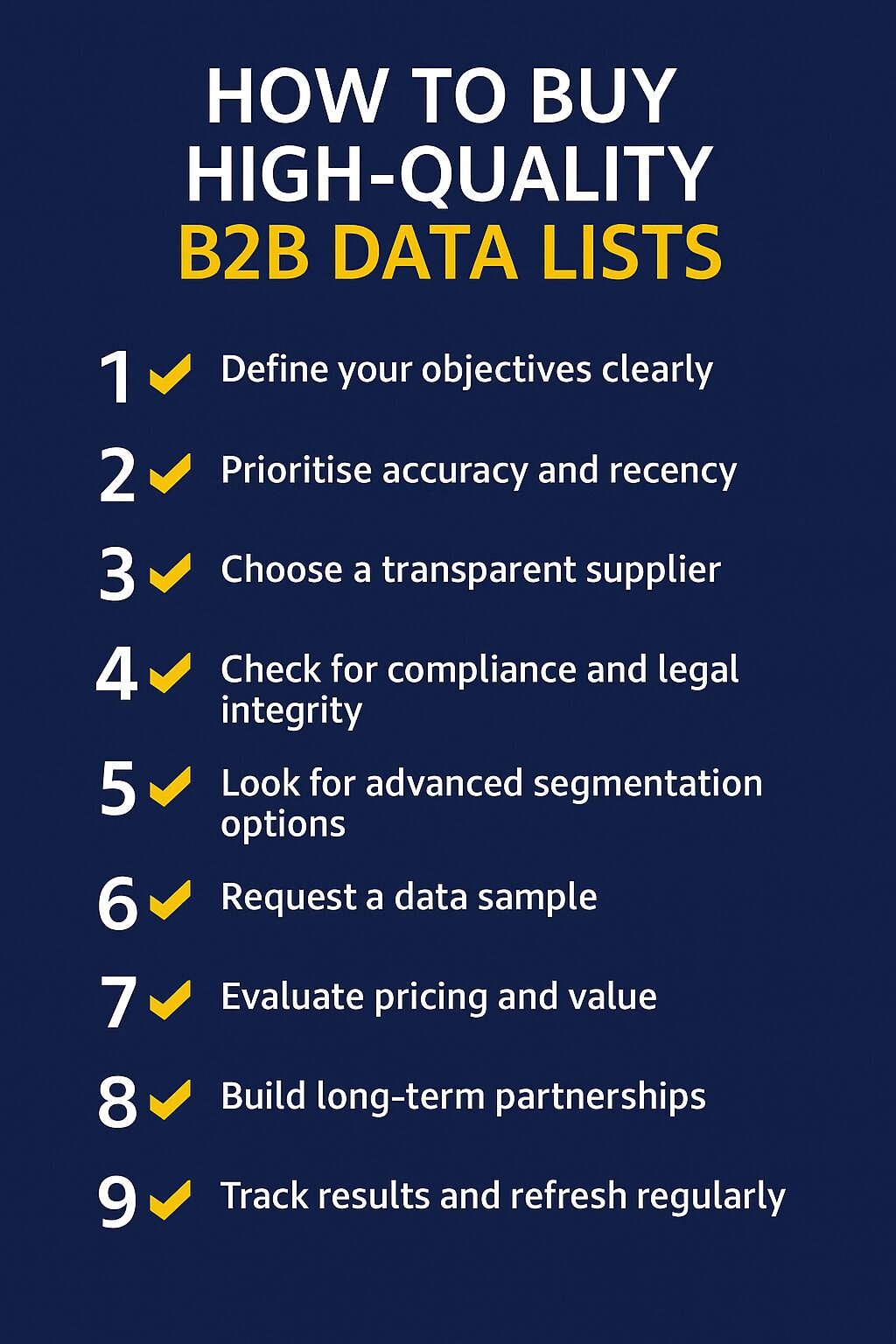
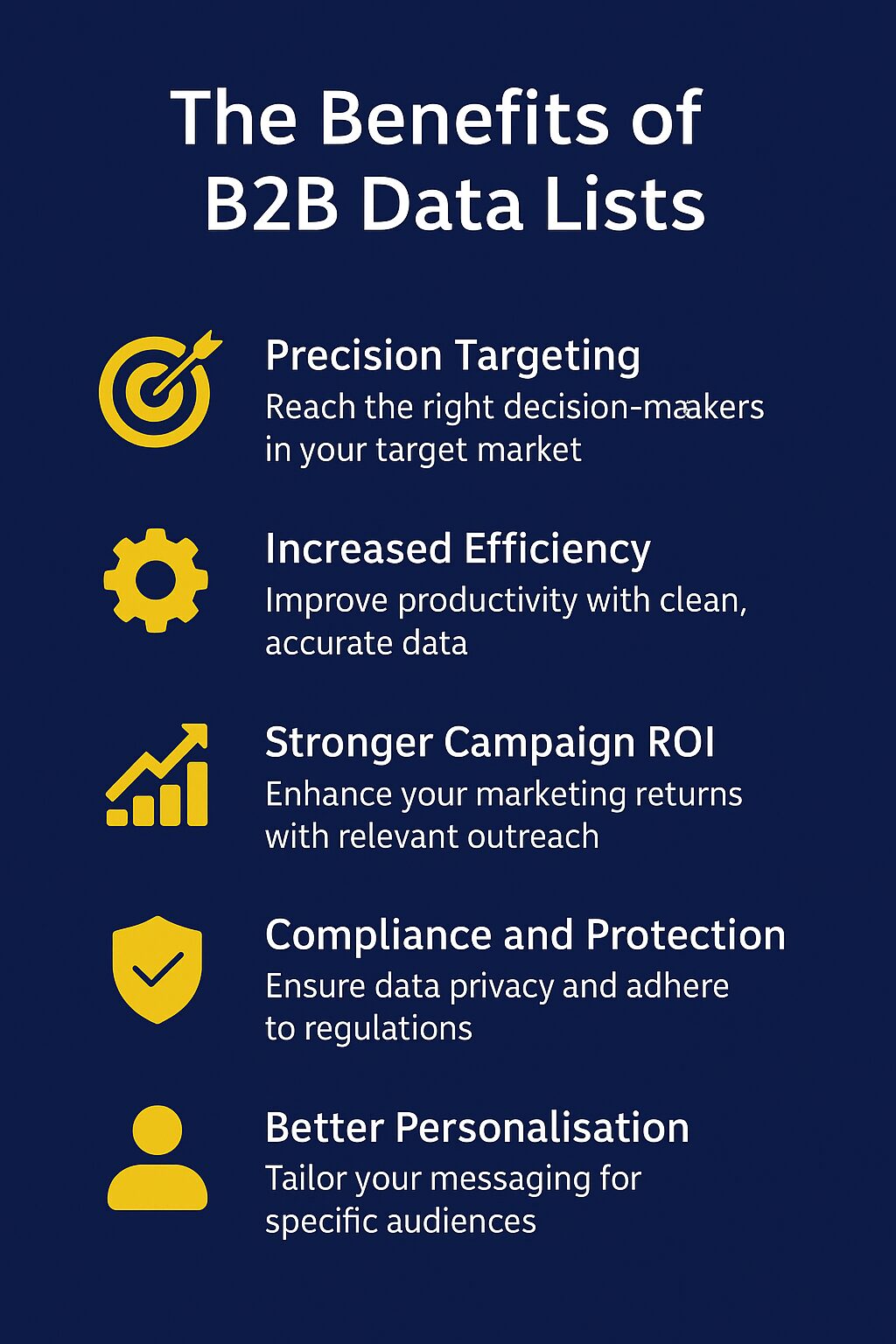
Advantages and Disadvantages of B2B Sales Leads Database
Navigating the world of B2B can sometimes feel like walking a tightrope. On one side, you have the undeniable benefits of a B2B sales leads database, and on the other, the potential pitfalls. Let’s dive in, shall we, and explore both sides of the coin?
What are the advantages of b2b sales leads database?
Ah, the allure of a well-maintained B2B sales leads database. Here’s what makes it so enticing:
- Precision Targeting: Imagine being able to reach out to the exact audience you have in mind. No more scattergun approach, just laser-focused marketing.
- Time Efficiency: Gone are the days of cold calling and hoping for the best. With a robust database, you know who you’re reaching out to, and more importantly, why.
- Data-Driven Insights: Knowledge is power, they say. A B2B sales leads database provides invaluable insights into market trends, customer behaviour, and so much more.
- Enhanced ROI: With targeted marketing efforts, businesses often see a higher return on investment. After all, you’re reaching out to those who matter.
What are the disadvantages of a b2b sales leads database?
But, as with all things, there’s another side to the story. Here are some potential challenges:
- Maintenance Overhead: A database, no matter how comprehensive, requires regular updates. This can sometimes be resource intensive.
- Data Decay: Business data can become obsolete pretty quickly. If not updated, the database can lose its relevance.
- Potential for Misuse: In the wrong hands, a B2B sales leads database can lead to spammy marketing practices, potentially harming a brand’s reputation.
- Cost Implications: Building and maintaining a quality database can sometimes be a costly affair, especially for small businesses.
How to Qualify B2B Sales Leads for Better Results
Not all leads are created equal. The real value of a B2B sales leads database comes when you can separate the high-quality prospects from the time-wasters. By qualifying leads properly, you can focus your sales and marketing energy where it matters most.
1. Match Against Your Ideal Customer Profile (ICP)
Start by defining the characteristics of your best customers—industry, company size, turnover, and decision-maker role. Then score your B2B sales leads against that profile. The closer the match, the higher the lead quality.
2. Look for Buying Signals
Strong B2B sales leads usually show intent, such as:
-
Downloading a resource or case study
-
Attending a webinar or event
-
Engaging with your emails or LinkedIn posts
Tracking these behaviours helps you prioritise leads most likely to convert.
3. Use Lead Scoring Systems
Assign points to each lead based on factors like job seniority, engagement activity, and company fit. This allows your team to focus on warm, high-potential prospects rather than chasing cold names.
4. Align Sales and Marketing Feedback
Your sales team is on the front line. Their feedback on which leads progress (and which don’t) should continuously feed back into how you manage and segment your database.
At Results Driven Marketing, our databases are built to align with your ICP from the start—so you don’t waste time and money on irrelevant records.
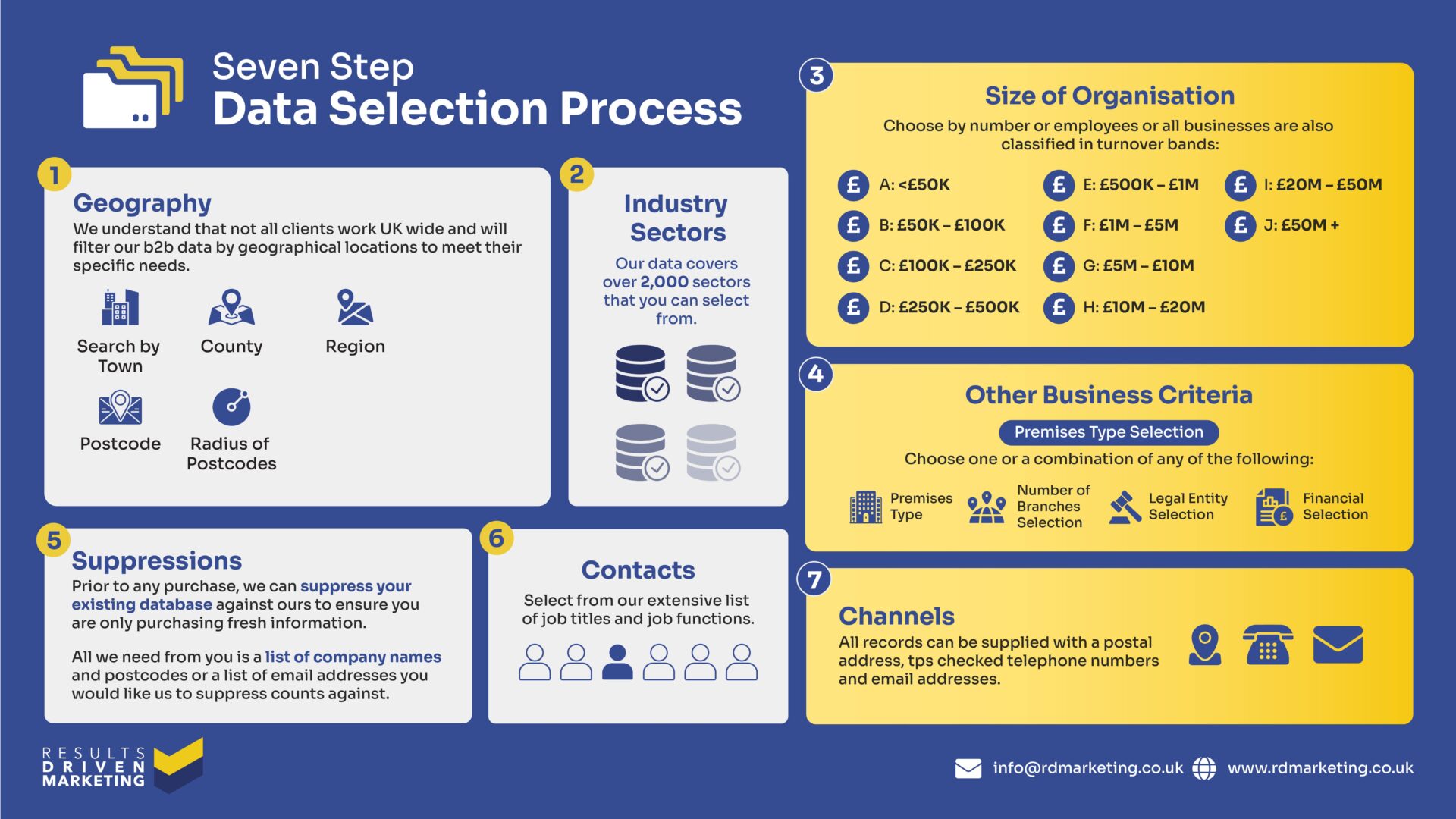
How to Turn B2B Sales Leads into Pipeline (Without Wasting Time)
A steady flow of b2b sales leads only helps if you can convert them into real conversations and opportunities. Use the framework below to qualify faster, message smarter, and keep your data working long after the first send.
Qualify First, Then Scale
-
Match to ICP: Filter by industry/SIC, employee band, turnover and seniority. If a lead doesn’t fit, don’t burn time on it.
-
Score signals: Give points for actions (opens, clicks, form fills, webinar sign-ups) and for fit (role, region, company size). Prioritise the top tier for outbound.
-
De-dupe & suppress: Remove customers, competitors and past opt-outs before any outreach. It protects deliverability and saves dials.
Write Messages That Earn Replies
-
Segment by role: Owners/MDs care about outcomes; Finance about cost/ROI; Ops about reliability and risk.
-
Open with context: One line tied to the lead’s sector or timing (regulation, seasonality, local factor).
-
One clear CTA: “Worth a 10–15 min call to confirm fit?” beats multiple links and vague asks.
Orchestrate Channels for Momentum
-
Email → Phone → LinkedIn → (Optional) Direct mail: 12–14 business days, 4–5 touches total.
-
Call the warmest first: Use engagement data to prioritise openers and clickers.
-
Tighten the loop: Push replies, meetings and outcomes back to CRM so future cadences get smarter.
Keep Data Clean, Compliant, and Current
-
Quarterly cleanse: Remove bounces, role changes and duplicates; enrich missing fields (turnover, region, seniority).
-
GDPR/PECR/CTPS ready: Offer a clear opt-out, record provenance, and screen phone numbers before dialling.
-
Replace policy: If you buy additions to your b2b sales leads, insist on accuracy guarantees and replacements for hard bounces.
Measure What Matters (By Segment)
Track deliverability → replies → meetings → pipeline £ at the segment level, not just overall. Promote winners, pause laggards, and top up only where performance justifies it.
Quick start checklist: ICP defined • Seed list cleansed • 14-day cadence set • Role-based templates written • CTPS screened • CRM feedback loop live.
How to Maximise ROI from a B2B Sales Leads Database
A B2B sales leads database is only as powerful as the way you use it. Simply buying access to thousands of records won’t guarantee results—you need a clear strategy for turning that data into opportunities.
1. Align Data with Your Ideal Customer Profile (ICP)
Start by mapping your B2B sales leads database against your ICP. Filter by industry, job role, company size, and turnover so you’re only contacting businesses most likely to convert. This saves time, reduces wasted spend, and ensures your campaigns hit the mark.
2. Personalise Outreach at Scale
Generic messaging is the fastest way to get ignored. Use the data fields in your database—such as job title, sector, or geographic location—to create tailored emails, phone scripts, and direct mail campaigns that resonate with each segment.
3. Keep Data Fresh and Clean
Outdated information leads to bounced emails and frustrated sales teams. Run regular cleansing and enrichment processes to keep your B2B sales leads database accurate and compliant. At Results Driven Marketing, our data cleansing services ensure you’re always working from a healthy, reliable dataset.
4. Use Multi-Channel Campaigns
Don’t rely on just one channel. A strong B2B sales leads strategy combines:
-
Email marketing for scalable outreach
-
Telemarketing data to connect directly with decision-makers
-
Direct mail for high-impact, tangible touchpoints
-
LinkedIn campaigns for visibility and credibility
When you integrate multiple touchpoints, your chances of conversion increase significantly.
5. Track and Optimise Campaign Performance
The best way to extract value from your B2B sales leads database is to measure outcomes. Track KPIs such as open rates, call connections, and conversion ratios. Use this data to refine segmentation, messaging, and targeting for future campaigns.
???? In short, a well-maintained B2B sales leads database doesn’t just provide contacts—it powers a repeatable system for pipeline growth and long-term ROI.
How A B2B Sales Leads Database Works With Your CRM
A b2b sales leads database really comes into its own when it is tightly connected to your CRM and day to day sales workflow. Instead of sitting in a separate spreadsheet that nobody trusts, it becomes the fuel that keeps your CRM full of fresh, relevant opportunities that your team can actually work with.
If you get this link right, you shorten sales cycles, avoid duplication, and get far more value from every record you buy.
From Static List To Live Pipeline
On its own, a b2b sales leads database is a high quality starting point. Once it is imported into your CRM, it turns into a live pipeline that your team can filter, sort, and progress.
In practice that means you can:
-
Assign leads to specific salespeople or territories
-
Tag records by sector, size, or decision maker role
-
Log every call, email, and meeting against the same record
-
Track stages such as cold, engaged, qualified, proposal, and won
Instead of repeatedly exporting and reworking lists, your CRM becomes the single place where marketing and sales can see exactly what is happening with every lead in the database.
Using CRM Data To Improve Your B2B Sales Leads Database
The relationship is two way. Your CRM does not just receive data from your b2b sales leads database, it also sends useful information back.
Over time you start to see:
-
Which sectors respond best to your offers
-
Which job titles move fastest through the pipeline
-
Which regions are most profitable
-
Which campaigns generate the highest conversion rates
You can then use those insights to refine future selections from your b2b sales leads database, focusing budget on the profiles that actually turn into revenue. At Results Driven Marketing, this is exactly how we help clients fine tune their selections over time so they are not starting from scratch with every campaign.
Keeping Both Systems Clean, Compliant, And In Sync
The biggest frustration for most teams is messy, duplicated data. To avoid that, your b2b sales leads database and CRM should be kept in sync with some simple habits:
-
De-duplicate on import so you are not creating multiple records for the same business
-
Regularly remove bounces, role changes, and opt outs from both systems
-
Record consent and contact preferences clearly so future campaigns stay compliant
-
Use standard fields for sector, company size, and job role so reporting stays accurate
Treating your database and CRM as one connected ecosystem means your sales team always has confidence in the information in front of them and your marketing activity is built on a solid, dependable foundation.
Why B2B Sales Leads Are the Engine of Growth
When it comes to business development, few assets are as valuable as a consistent stream of B2B sales leads. They fuel your pipeline, keep your sales team active, and ultimately drive revenue growth. But their real power comes from quality and strategy—not just quantity.
The True Value of B2B Sales Leads
-
Direct Access to Decision-Makers – Whether it’s a Managing Director, Marketing Manager, or Operations Lead, sales leads connect you with the people who can make purchasing decisions.
-
Predictable Pipeline – A reliable source of leads means fewer peaks and troughs in your sales activity, giving you steadier growth.
-
Informed Strategy – Analysing your leads uncovers patterns in industries, company sizes, or regions that deliver the best results, helping you refine targeting.
Quality Over Quantity
It’s easy to be tempted by big numbers, but the best B2B sales leads are:
-
Accurate and up to date (to avoid wasted calls or bounced emails).
-
Relevant to your offer, filtered by industry, company size, or role.
-
GDPR and CTPS compliant, so you can market legally and confidently.
Turning Data Into Conversations
A list of B2B sales leads is only as valuable as the conversations it sparks. Successful businesses treat leads as opportunities to build relationships, not just contacts to tick off. With a targeted approach, every outreach effort becomes a chance to engage, qualify, and progress towards a sale.
???? In short: B2B sales leads are the bridge between marketing activity and sales results. Get them right, and you accelerate growth. Get them wrong, and you risk wasted effort.
How to Generate and Use B2B Sales Leads Effectively
When people talk about B2B sales leads, they’re often thinking about more than just names on a spreadsheet. A good lead is a potential customer who matches your ideal profile, has decision-making power, and is open to being contacted. The challenge is finding these leads consistently—and that’s where accurate data makes all the difference.
Building B2B Sales Leads from the Right Sources
There are plenty of ways to generate B2B sales leads, but not all are efficient or compliant. Some of the most effective methods include:
-
Targeted B2B Data Lists – Pre-built datasets segmented by sector, job title, turnover, or location.
-
Direct Mail Data – Verified postal records that allow you to reach businesses in a personal, tangible way.
-
Telemarketing Data – CTPS-screened contact numbers so your team can confidently connect with decision-makers.
-
Email Address Lists – GDPR-compliant email records for campaigns that scale quickly and cost-effectively.
At RD Marketing, all of these data services are designed to deliver sales-ready leads that align with your campaigns from day one.
Turning Leads into Sales Opportunities
Getting access to B2B sales leads is only the first step—the real value comes from how you use them. Best practices include:
-
Segmentation: Break your leads into smaller groups by role, industry, or company size. This makes outreach more relevant and increases engagement.
-
Personalisation: Use data enrichment to tailor your message—referencing industry challenges or company size, for example.
-
Multi-channel outreach: Combine email, phone, and direct mail for maximum visibility and response rates.
-
Regular data cleansing: Outdated leads waste time. By cleaning and updating your lists, you keep your sales pipeline healthy and responsive.
Why This Matters for SMEs
For smaller businesses, every lead counts. High-quality B2B sales leads mean:
-
Less time wasted on unqualified contacts.
-
Faster progress from cold outreach to real conversations.
-
A better ROI on every campaign.
With the right partner, you can make sure your sales team is always working from a database built to deliver results. RD Marketing specialises in providing the accurate, compliant, and actionable data that SMEs need to consistently win new business.
Is a b2b sales leads database a good idea?
The million-dollar question. Well, the answer isn’t a simple yes or no. A B2B sales leads database, when used correctly, can be a game-changer. It can streamline marketing efforts, enhance outreach, and boost sales. However, it’s essential to ensure that the database is accurate, up-to-date, and used responsibly.
What are the key considerations of a b2b sales leads database?
Opting for a B2B sales leads database? Here are some things to keep in mind:
- Data Accuracy: Ensure that the data is accurate and verified. An outdated database can do more harm than good.
- Integration Capabilities: The database should seamlessly integrate with your existing systems, be it CRM or marketing automation tools.
- Customisation: Every business is unique. The database should offer customisation options to cater to specific business needs.
- Support and Training: Especially if you’re new to the world of B2B databases, having a supportive provider can make all the difference.
How B2B Marketing Leads Drive Campaign Success
Turning Data into Opportunities
A well-structured B2B sales leads database is only valuable if it’s used to generate B2B marketing leads that convert. By combining accurate data with tailored campaigns, businesses can transform static records into live opportunities that feed the sales pipeline.
Benefits of Using Databases for B2B Marketing Leads
-
Targeted Outreach: With access to verified decision-makers, you can focus campaigns on businesses that align with your ideal client profile.
-
Improved Conversion Rates: High-quality data ensures you’re speaking to the right people, reducing wasted effort and boosting response rates.
-
Efficient Campaign Planning: Segmenting by industry, location, or company size makes it easier to run campaigns that resonate with specific audiences.
-
Scalable Growth: Whether you’re targeting 500 prospects or 50,000, a database makes it simple to scale lead generation without sacrificing accuracy.
Why Work with Results Driven Marketing?
At Results Driven Marketing, our B2B databases are built to supply not just contacts, but B2B marketing leads that deliver real commercial results. Every dataset is GDPR-compliant, regularly updated, and tailored to your campaign goals—whether that’s email, telemarketing, or multi-channel outreach.
By starting with accurate data, your marketing activity becomes more efficient, more targeted, and ultimately more profitable.
What are the alternatives to b2b sales leads database?
In the vast universe of business tools and strategies, while the B2B sales leads database stands out as a shining star, it’s not the only constellation in the sky. Let’s embark on a little journey to explore some of the other options out there:
- Networking Events: The good old-fashioned way. Attending trade shows, seminars, and business conferences can be a goldmine for sourcing business contacts. It’s all about the human touch, after all.
- Social Media Outreach: Platforms like LinkedIn, Twitter, and even Facebook have become hubs for B2B interactions. Engaging in meaningful conversations, joining industry-specific groups, and even direct outreach can yield fruitful results.
- Referral Programs: Encouraging your existing clients or partners to refer potential leads can be an effective strategy. After all, word-of-mouth still holds considerable weight in the business world.
- Industry Publications: Subscribing to industry magazines, journals, and newsletters can provide insights into potential leads and market trends.
While each of these alternatives has its own set of advantages, it’s essential to find the one that aligns best with your business goals and strategies.
FAQ
Q: Why does your business need a B2B contact database?
A: A B2B contact database streamlines and enhances outreach efforts, ensuring that marketing and sales initiatives are directed towards the right audience. It aids in targeted marketing, efficient lead generation, and data-driven decision-making.
Q: What to look for in B2B contact database providers?
A: Key considerations include data accuracy, customisation options, ease of use, and the level of support and training provided. It’s also essential to ensure seamless integration with existing systems.
Q: Where do you find business contacts for your database?
A: Business contacts can be sourced from various platforms, including online platforms like LinkedIn, networking events, referrals from existing clients, and industry publications.
Q: How do you tell if your database for B2B contacts is out-of-date?
A: Signs of an outdated database include high email bounce rates, decreased engagement, inaccurate information, and feedback from sales teams indicating issues with the leads.
Q: What’s the best way to build a B2B contact database?
A: Building a robust B2B contact database involves defining your target audience, leveraging online platforms, attending networking events, seeking referrals, and considering purchasing from reputable providers.
Q: How do you improve your B2B marketing database?
A: Improving a B2B marketing database involves regular cleansing to remove duplicates and update outdated information, segmentation for targeted marketing, establishing a feedback loop with sales teams, and integrating with CRM systems for real-time updates.
Conclusion
In the dynamic arena of B2B commerce, the significance of a robust B2B sales leads database cannot be understated. Such databases serve as the foundation for building meaningful business relationships, targeting precise markets, and crafting personalised outreach strategies.
They are the gateways to untapped opportunities, enabling businesses to evolve, adapt, and thrive in competitive environments. As we’ve journeyed through the intricacies of these databases, it’s evident that their value extends beyond mere numbers or contact details; they represent the potential for growth and innovation.
In a world where timely and relevant connections matter, investing in and understanding the essence of a B2B sales leads database is the key to future-proofing business endeavours and driving sustainable success.
Who are we?
Providing b2b database solutions is our passion.
Offering a consultancy service prior to purchase, our advisors always aim to supply a database that meets your specific marketing needs, exactly.
We also supply email marketing solutions with our email marketing platform.
We have the best data of email lists for your networking solutions as well as direct mailing lists & telemarketing lists
A good quality b2b database is the heartbeat of any direct marketing campaign…
It makes sense to ensure you have access to the best!
Call us today on 0191 406 6399 to discuss your specific needs.
Results Driven Marketing
0191 406 6399